Dragoljub Zamurovic
1. Congratulations on winning in the European Photography Awards! Can you share a little about yourself, what inspired you to pursue photography, and how has your journey evolved since your first shot?
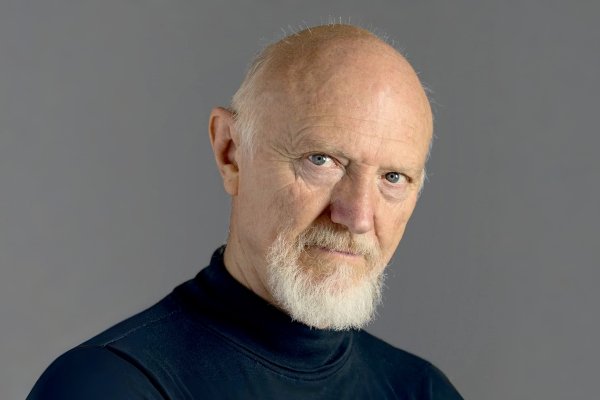
I originally studied architecture, and I believe that education has strongly influenced the way I see and compose photographs. Photography gradually became my true profession, and for more than four decades I have documented people, places and events, particularly in Serbia and the former Yugoslavia.
Over the years, my photographs have been published internationally in magazines and newspapers including LIFE, TIME, GEO, Le Figaro Magazine and The New York Times Magazine, and I have also published several photographic monographs.
My photography has changed together with the world around me and with the technology available to photographers. I began with film and spent many years working as a documentary photographer, often photographing major historical events at ground level and at very close range. Later, digital photography opened new possibilities, and drones gave me something particularly exciting: an entirely new point of view.
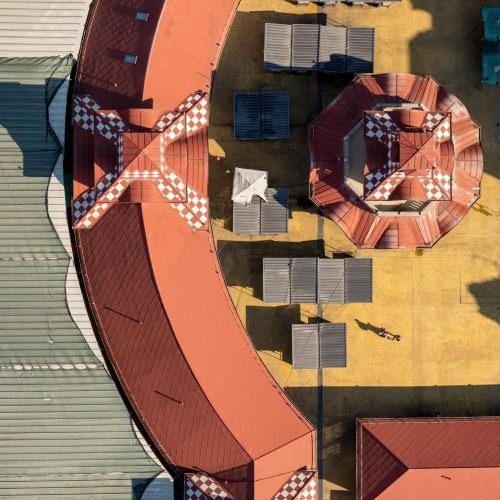
Looking straight down from the sky, I discovered that landscapes and architecture could become almost abstract compositions of lines, shapes, colours and shadows. In a way, this brought me back to architecture, which is where my visual education began. After all these years, photography still gives me the same pleasure it did at the beginning: the possibility of discovering something familiar and seeing it in a completely new way.
2. Can you share the story or inspiration behind your award-winning piece? How does winning this award make you feel about your journey in photography?
The series Aerial Geometry grew naturally from two important parts of my life: my early education in architecture and my more recent fascination with aerial photography.
When I began working with drones, I discovered that looking vertically down could completely transform familiar architecture. Buildings stopped being buildings in the conventional sense. Roofs, stairways, courtyards and façades became lines, circles, rectangles, patterns, colours and shadows. I began searching deliberately for places where architecture could be reduced to this visual language.
Winning a Gold Award for this series means a great deal to me because it confirms something I have always believed: a photographer should never stop looking for new ways of seeing. After more than four decades in photography, I can still be surprised by what a camera can reveal. For me, that sense of discovery is more important than ever.
3. How do you decide which photo to submit for a competition?
I try not to choose a photograph simply because it is beautiful or technically perfect. For a competition, I look for an image that has something more — a strong idea, an unusual point of view, an emotion, or a visual element that makes you stop and look again.
I also try to judge my own photographs as if I had not taken them. That is not always easy. Photographers often become emotionally attached to the circumstances in which an image was made, while the jury sees only the photograph itself.
When submitting a series, the selection becomes even more demanding. Each photograph must be strong on its own, but at the same time all the images have to belong together and strengthen the central idea of the series.
4. What first made you pick up a camera?
I was drawing long before I discovered photography. As a child, I drew constantly — with a graphite pencil on paper, on old family photographs, on walls, and even underneath tables and chairs. I drew people, animals, houses and everything I saw around me.
When I was twelve, good colour reproductions of great works of art were very difficult to find in Yugoslavia. One day, in a second-hand bookshop, I discovered several issues of Life magazine. In one of them was a beautiful reproduction of Rubens' Venus at a Mirror. I spent my entire month's pocket money buying all the issues, hoping to find more paintings.
I did not. Instead, I found something much more important: photography.
Until then, I had thought of photography mainly as a record of something that had happened. In Life, I discovered that a photograph could be creative, powerful and meaningful in its own right. That discovery changed the direction of my life.
With the first money I earned working as an assistant gymnastics coach, I bought my first camera, a Smena 6. I was never particularly interested in photographing friends or relatives. From the beginning, I wanted to experiment and, inspired by Life, dreamed of making exceptional photo-reportages.
One of my first opportunities came while I was on holiday with my parents in Biograd na Moru. President Tito was visiting the town. After his motorcade had passed through the crowded streets, I realised that, because of the layout of the roads, he would probably have to leave by another road on the opposite side of a wooded area.
I grabbed my Smena 6 and ran barefoot through the woods in my swimming trunks. I reached the road just as the motorcycles and an open car carrying Tito and his wife Jovanka appeared around the bend. Nobody else was there. As they passed, they waved to me, and I took the photograph. I began to believe that perhaps I had the instincts of a photojournalist.
My first published photograph appeared in the newspaper Politika Ekspres in 1963. A motorcycle caught fire in front of the building where I lived. I heard the commotion, ran outside with my camera and photographed it in flames. That was the first time one of my photographs appeared in print.
Later, Life and National Geographic became my informal photography school. I divided the photographs I saw into two groups: those I thought were successful and those I thought were less successful. Instead of simply admiring the photographs I liked and trying to imitate them, I asked myself how I would have photographed the same situation if I had been there.
Looking back, I think that was one of the most important things I did as a young photographer. It taught me not to copy someone else's way of seeing, but to develop my own.
5. What’s your favorite type of photography, and why do you love it?
I have always loved photographing from above. Long before drones existed, I was constantly looking for ways to gain height. In my younger years, I climbed trees, rooftops and utility poles — even electricity pylons, which I now realise were extremely dangerous and something I certainly would not recommend.
Later, I spent a great deal of time photographing from aeroplanes, helicopters and motorised hang gliders. I was always fascinated by the way an elevated viewpoint transforms the world below. Familiar landscapes, buildings and roads suddenly become shapes, patterns and compositions that cannot be seen from the ground.
At one point, I began thinking about hot-air balloons. Because a balloon moves so peacefully through the air, I thought it could provide an ideal platform for photography, allowing me to use slower shutter speeds and work even in lower light. I contacted Saša Dobrosavljević, who was very active in ballooning at the time, and with his advice I eventually bought my own balloon.
It was an unusual balloon without a traditional basket — it had only a single seat. This made it smaller and much more manoeuvrable than a conventional balloon. I could land in places where a larger balloon could not, and under suitable conditions take off again and continue photographing. It gave me an extraordinary freedom to explore the landscape from the air.
Then drones appeared, and for me they were a natural continuation of something I had already been doing for many years. The difference was that suddenly I could place a camera almost exactly where I wanted it in the sky and explore viewpoints that had previously been impossible.
Today I frequently work with a DJI Mavic 4 Pro. Whenever conditions allow and I have some free time, I take the drone with me and look for something I have never seen from that particular point of view. Aerial photography remains one of my favourite forms of photography because even after decades of looking at the world from above, it can still surprise me.
6. What’s your go-to camera setup, and why does it work best for your projects? What’s your favorite feature?
For my current aerial projects, my main camera is the DJI Mavic 4 Pro. What matters most to me is not simply that it flies, but that it gives me extraordinary freedom in choosing exactly where I want the camera to be.
In traditional aerial photography, whether I was working from an aeroplane, helicopter or balloon, I always had to adapt myself to the movement and limitations of the aircraft. With a drone, I can do the opposite: I can move the camera until the composition is exactly where I want it, change the altitude, adjust the angle, wait for the right light, and make very small positional corrections.
The Mavic 4 Pro also gives me several focal-length options, which is particularly useful. Aerial photography does not always benefit from the widest possible view. Sometimes a longer focal length allows me to isolate a small section of the landscape or architecture and turn it into a much stronger composition.
If I had to choose my favourite feature, however, it would not be one particular technical specification. It would be the ability to place the camera in a position in three-dimensional space that would otherwise be impossible to reach. For me, that freedom of viewpoint is the most important feature a drone can offer a photographer.
7. If someone looked at your work, what’s the one thing you’d want them to feel?
I would like them to feel curiosity.
For me, photography has always been about discovering something — sometimes an extraordinary event, sometimes an ordinary moment that suddenly becomes extraordinary, and sometimes a familiar place seen from an unexpected point of view.
I do not necessarily want to tell the viewer what to think or feel. I would rather make them stop for a moment, look more carefully, and perhaps ask themselves: “Why have I never noticed this before?”
If a photograph makes someone look at the world with a little more curiosity after seeing it, then I think it has achieved something important.
8. What was the most challenging part of capturing your winning shot?
Since Aerial Geometry is a series rather than a single photograph, the greatest challenge was not capturing one particular moment, but finding architecture that could be transformed into a strong composition when seen from directly above.
From the ground, a building may look interesting, but that does not necessarily mean it will work from the air. And sometimes the opposite happens: a completely ordinary place suddenly reveals an extraordinary geometry when viewed vertically from above.
The challenge is to recognise that possibility and then find the exact position, altitude and focal length where all the elements come together. Moving the drone only a few metres can completely change the relationship between lines, shapes and shadows.
Light is also crucial. I often have to wait for the right time of day, because shadows can either strengthen the geometry or destroy it.
Perhaps the most challenging — and most exciting — part is that I never know exactly what I will discover until the drone is in the air. I may have an idea before take-off, but very often the best photograph is something I did not know was there.
9. Is there a specific place or subject that inspires you the most?
I don't think there is one particular place that inspires me most. I am more interested in the possibility of discovering something unexpected in places that may initially seem completely ordinary.
Serbia has been my main photographic territory for much of my life, and I still find subjects here that surprise me. I can return to the same landscape, town or building many times and see something different because the light has changed, the season is different, or I am simply looking at it from another point of view.
I am especially attracted to the relationship between people and the spaces they create or inhabit. This can be a major historical event, an everyday scene in a village, a landscape transformed by agriculture, or the geometry of a building seen from the air.
Perhaps the subject that inspires me most is not a place at all, but transformation — the moment when something familiar, through light, timing or viewpoint, becomes unfamiliar. That is usually when I know there may be a photograph.
10. Who or what has been your biggest influence in photography?
My greatest influence was probably not one particular photographer, but two magazines: Life and National Geographic.
I discovered Life when I was twelve, and it completely changed my understanding of photography. Until then, I had thought of a photograph mainly as a record of reality. Life showed me that photography could tell stories, create emotion and have the visual power of an art form.
Later, when I began studying photographs in Life and National Geographic more seriously, I developed a habit that became very important to me. I would look at a photograph and ask myself not only whether I liked it, but why it worked — and, even more importantly, how I would have photographed the same situation if I had been there.
Many great photographers have influenced and inspired me over the years, but I have always tried not to imitate them. I believe influence is most valuable when it teaches you how to think rather than how to copy.
Perhaps that is the greatest lesson those magazines gave me: they did not teach me what to photograph. They taught me to look.
11. What message would you share to inspire photographers to participate in photography awards, and what advice would you give to help them excel in the competition?
I would encourage photographers to enter competitions even if they are uncertain about their chances of winning. An award is wonderful, of course, but the process of choosing what to submit can be just as valuable.
A competition forces you to become the editor and critic of your own work. You have to separate the memory and emotion connected with making a photograph from what is actually visible in the image. A photograph may be very important to you because of the circumstances in which you took it, but the jury knows nothing about those circumstances. They see only the photograph.
My advice is therefore simple: be demanding when selecting your work. Do not submit an image merely because it is technically perfect or because it was difficult to make. Ask yourself whether it has something that will make a person who knows nothing about you stop and look.
At the same time, I would not recommend trying to predict what a jury wants. Trends change, juries change, and photography changes. If you begin making photographs primarily to win competitions, you risk losing your own voice.
Submit the work you genuinely believe in, learn from both success and rejection, and continue developing your own way of seeing. Winning an award is gratifying, but having a recognisable photographic voice is much more important.
12. What’s one piece of advice for someone just starting in photography?
Learn to look before you learn to photograph.
Today it is relatively easy to master the technical side of photography. Cameras are extremely capable, and almost any technical question can be answered in seconds. What takes much longer to develop is your own way of seeing.
Look at great photography, but do not try to reproduce it. Ask yourself why a particular photograph affects you, what makes it successful, and what you might have done differently if you had been standing behind the camera.
And photograph as much as possible. Do not wait for exotic places, perfect light or extraordinary events. Some of the best photographs can be found very close to home if you learn to notice what other people pass by without seeing.
Technique can be learned relatively quickly. Learning to see is a lifelong process — and, for me, that is the most exciting part of photography.
13. What role do editing and post-processing play in your creative workflow?
Editing and post-processing are important parts of my workflow, but I see them as a continuation of photography rather than a way of creating a different reality.
I started photography in the analogue era, when decisions about exposure, film, development and printing were already part of the interpretation of an image. Digital photography has simply given us much more precise tools for doing what photographers have always done in the darkroom.
I usually work carefully with exposure, contrast, colour, shadows and highlights, and sometimes with cropping, but my aim is to strengthen what was already present when I took the photograph. I do not want post-processing to become more important than the photograph itself.
This is particularly important to me because much of my career has been devoted to documentary photography. I believe there is a line between interpreting a photograph and changing the reality it represents, and I try not to cross that line.
With my aerial and more abstract work, such as Aerial Geometry, I may have somewhat more freedom in emphasising colour, form and geometric relationships. Even then, however, the essential elements of the image are discovered with the camera, not created afterwards on the computer.
For me, the strongest photograph is one that is already there at the moment of exposure. Post-processing should help us see it more clearly.
14. How do you see technology, like AI, influencing the future of photography and your own approach?
I have lived through enormous technological changes in photography — from film and the darkroom to digital cameras, sophisticated editing software, drones and now artificial intelligence. Each new technology was initially viewed with some suspicion, and each eventually became another tool available to photographers.
I believe AI will be extremely useful in many parts of the photographic process. It can already help us organise large archives, search for images, improve technical quality and make certain editing tasks faster and more precise. I see no reason to reject these possibilities simply because they are new.
However, I think we need to make an important distinction between a photograph and an AI-generated image. For me, photography begins with something that existed in front of a camera at a particular moment. That connection with reality has always been one of photography's greatest strengths.
An AI-generated image can be beautiful, creative and artistically valuable, but if no camera recorded it and the scene never existed, I would describe it as a different form of visual art rather than photography.
In my own work, I am happy to use new technology when it helps me realise or present a photograph more effectively, but I want the essential content of the image to come from the world I actually encountered.
Technology will continue to change, probably faster than we can imagine. But I believe the photographer's most important tools will remain the same: curiosity, judgement, timing and the ability to see.
15. If you could photograph anything or anyone in the world, what would it be?
I don't think I have one particular person or place on my wish list. What excites me most is being given a subject and then having the opportunity to explore it deeply with my camera.
I have always enjoyed assignments of this kind. One that I remember with particular pleasure was when the editor of National Geographic Magazine in Serbia asked me to photograph a story about falconers. I worked on the assignment for six months. It gave me time not only to photograph the subject, but to understand it, return to it again and again, and wait for situations that could never have been planned in advance.
Everyone was very pleased with the finished story, and I was especially happy when the edit received a “Best Edit” recognition from the National Geographic editors in Washington. For me, that was confirmation of something I had always believed: when a photographer is given enough time to understand a subject, the photographs can go far beyond simple illustration.
So if I could photograph anything in the world, I would perhaps not choose a famous person or an exotic destination. I would choose an interesting subject that I know very little about, and enough time to discover it through photography.
After more than sixty years with a camera, what still excites me most is the possibility of beginning a new story without knowing what photographs I will find along the way.